We Can Always Get Better: How to Change Old Patterns
Getting better is not merely something we desire. It is a decision we live.
By Dr. Edward Wheeler | Founder, Total MindPower Institute
A Founder’s Reflection
We Can Always Get Better
Just because you have always done something a certain way does not mean it is the best way.
I have been reflecting on that thought, and the more I consider it, the more significant it becomes.
I like the word better.
Better does not require perfection. It does not demand that we condemn what we have done or who we have been. Better simply acknowledges that there may be another way, a more productive way, a more fulfilling way, or a way more consistent with the person we have decided to become.
We can always get better.
But getting better requires something of us.
It requires more than wanting things to change. It requires awareness, a willingness to question what has become familiar, and ultimately, the decision to behave differently.
And that is where things become interesting.
The Emotional Attachment to What Is Familiar
Why do we continue doing things that are no longer producing the results we desire?
Why do intelligent, capable people continue repeating patterns they consciously want to change?
I believe part of the answer lies in our emotional connection to what has become familiar.
We are creatures of habit, but our habits extend far beyond physical behaviors.
We develop familiar patterns of thinking, feeling, interpreting, and responding to the circumstances of our lives.
These patterns serve us in countless ways.
Imagine having to relearn how to recognize your name every morning, identify the people you love, spell familiar words, or perform the everyday activities you have practiced for years.
Our capacity to develop and retain these patterns is extraordinary.
But not every pattern serves us equally well.
Some patterns carry meanings we assigned to experiences years or even decades ago. Those meanings may have been influenced by the people around us, the circumstances we encountered, or the emotions we experienced at the time.
And because those patterns have become familiar, we may no longer recognize them as interpretations.
We experience them as truth.
The Beliefs We Don't Know We Have
Consider a simple phrase many of us heard growing up:
"Money doesn't grow on trees."
Perhaps it was spoken by a parent or grandparent. Perhaps it was repeated during times of financial difficulty or frustration.
The words themselves may have been intended to encourage responsibility.
But what if the emotional experience accompanying those words communicated something else?
What if the message we internalized was that money is scarce, difficult to obtain, or simply unavailable to people like us?
Repeated often enough, particularly when associated with strong emotions, an idea can become a deeply familiar assumption.
Years later, we may consciously desire prosperity while unconsciously interpreting financial opportunities through an expectation of scarcity.
We may hesitate to invest in ourselves, avoid opportunities, or make decisions based on what we fear losing rather than what we might create.
And we may not even recognize the belief influencing those decisions.
This is what makes the internal work so important.
Our paradigms—those established patterns of thought, belief, expectation, and behavior—help shape how we perceive and respond to the world.
We do not experience circumstances independently of our interpretation of them.
Our brain processes information through learned patterns of recognition. What we notice, what we expect, and what we believe can influence the meaning we assign to an experience.
That does not mean circumstances are imaginary or that real limitations do not exist.
It means the limits of our current perception are not necessarily the limits of what is possible.
And the fact that we have believed something for a long time does not make it true.
The Feeling Is the Signal
Here is where I believe the opportunity for meaningful change begins.
Suppose you consciously desire something different.
You want greater prosperity, more fulfilling relationships, improved health, greater confidence, or a new level of personal achievement.
You can imagine the result. You want it. Perhaps you want it very much.
Yet when you begin moving toward that desire, something happens internally.
You experience uncertainty.
Or fear.
Or resistance.
You begin questioning yourself. You hesitate. You find reasons to delay. Perhaps you return to familiar behaviors that have never produced the result you desire.
What is happening?
I believe we are often experiencing a lack of alignment between our conscious desire and our established patterns of belief and emotional response.
And the feeling associated with that conflict is significant.
I have taught for years that nothing is more important than what you feel.
I describe feeling as our conscious awareness of vibration, and I use the language of energy to help people recognize that different emotional states are associated with different experiences of life.
There is still much about human experience we do not fully understand. But we can recognize the practical influence of our emotional states.
Consider anger.
When we become consumed by anger, our attention may narrow. We may become defensive, reactive, and less receptive to alternative perspectives.
The circumstance itself may not have changed, but our experience of that circumstance has.
Our emotional state can influence what we recognize as possible and how we respond.
This is why I believe our feelings deserve our attention.
Not because every feeling tells us the truth about our circumstances.
But because a feeling can bring our internal experience into conscious awareness.
The feeling of uncertainty can become the trigger for awareness rather than the trigger for another familiar reaction.
And that changes everything.
Awareness Creates Choice™
One of the foundational doctrines of Total MindPower is Awareness Creates Choice™.
Choice is a function of awareness.
When we are unaware of the thoughts, beliefs, and emotional patterns influencing our behavior, we are more likely to repeat familiar responses.
But when we recognize what is happening, we create an opportunity.
We can interrupt the pattern.
We can question the meaning we have assigned to the circumstance.
We can remember what we desire and who we have decided to become.
And we can make a different choice.
There is something else we must learn to interrupt along the way.
Condemnation.
How often do we recognize a familiar pattern and immediately criticize ourselves?
"There I go again."
"I should know better."
"Why can't I get this right?"
But condemnation is not the same as awareness.
In fact, condemnation can become another familiar emotional pattern that keeps us connected to the very identity we are attempting to change.
I often remind my clients:
That's not condemnation. That's awareness.
The purpose of recognizing a pattern is not to judge ourselves for having it.
The purpose is to create the opportunity to choose.
We cannot change what we refuse to recognize.
But we do not have to condemn what we recognize in order to change it.
Re-enter the Possibility Loop
When we become aware of a familiar emotional response, particularly one associated with uncertainty or resistance, I suggest something simple.
Re-enter the Possibility Loop.
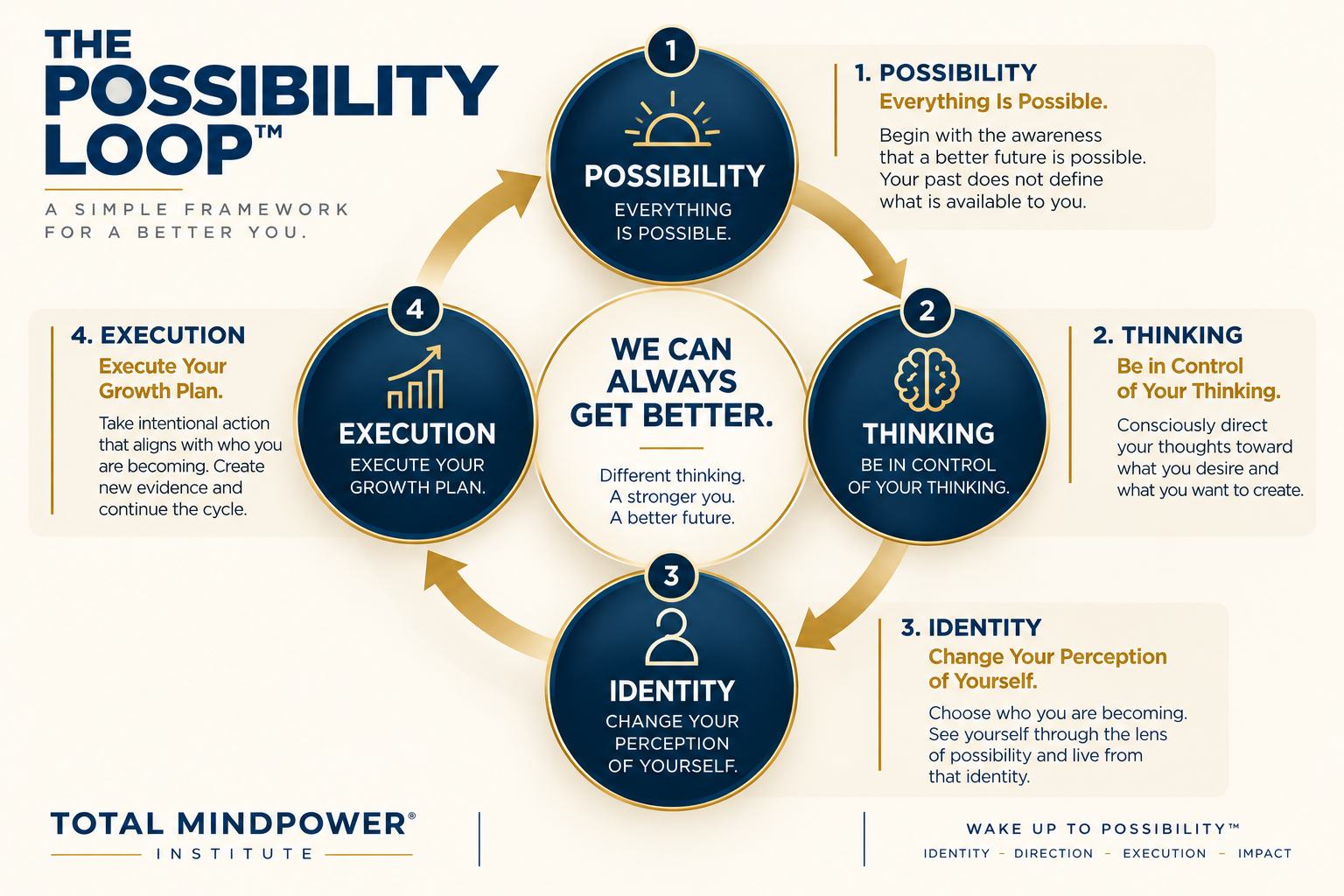
The Possibility Loop is a simple framework I use to remind myself that getting better begins with recognizing possibility. When we consciously direct our thinking, change our perception of ourselves, and execute a plan for growth, we begin creating evidence of the person we have decided to become. And with every new experience, we have another opportunity to return to possibility and continue growing.
Remember that your current results, past experiences, and familiar beliefs do not necessarily define what is possible for your future.
Begin by becoming intentional about your thinking.
Rather than allowing your attention to remain consumed by what might go wrong, consciously direct it toward what you desire to create.
Ask yourself:
How do I want this to be?
What would a better outcome look like?
What possibilities have I not yet considered?
Then consider your identity.
Who have I decided to be?
How would that person perceive this circumstance?
What would that person believe, feel, and choose to do?
This is where the practice of future feelings becomes especially meaningful.
We can consciously imagine the emotional experience associated with the good we desire.
We can practice gratitude, confidence, appreciation, enthusiasm, or whatever emotional state supports the direction we have chosen.
We are not pretending that our present circumstances are different.
We are consciously practicing the internal state we want to bring to those circumstances.
And then we must act.
Because ultimately, if we desire different results, something in our behavior must change.
We can think differently and practice feeling differently, but getting better must eventually become visible in what we do.
That is where intention becomes execution.
And execution begins creating new evidence of who we are becoming.
Getting Better Is a Decision We Live
I think we sometimes make personal growth more complicated than it needs to be.
We wait for certainty.
We wait until we feel completely confident.
We wait for the circumstances to become more favorable.
But what if uncertainty itself is the invitation?
What if the moment we recognize fear, hesitation, or resistance is precisely the moment we have an opportunity to practice becoming someone different?
We do not have to eliminate every uncomfortable feeling before taking meaningful action.
We can recognize the feeling, become aware of the pattern, remember our direction, and choose an action consistent with the person we have decided to become.
Sometimes the feeling changes before the action.
Sometimes the action helps change the feeling.
Either way, we are practicing conscious choice rather than automatic reaction.
And with practice, we can get better at recognizing these decision points.
Better at directing our thinking.
Better at choosing our emotional state.
Better at responding rather than reacting.
Better at executing the actions that move us toward our Worthy Ideal.
This is not about becoming perfect.
It is about becoming increasingly intentional.
I have often said that growth is how quickly we shift from reaction to response.
Perhaps that is one of the most meaningful measures of getting better.
Not that uncertainty disappears.
Not that familiar patterns never return.
But that we become increasingly capable of recognizing them, making a conscious choice, and continuing forward.
We Can Always Get Better
There is something wonderfully freeing about the word better.
It does not require us to reject our past.
Our past has taught us. Our experiences have contributed to who we are. Even patterns that no longer serve us may once have helped us navigate the circumstances of our lives.
We can appreciate what has brought us here without remaining confined to it.
Just because we have always thought something does not mean we must continue believing it.
Just because we have always reacted a certain way does not mean we must continue responding that way.
And just because our present results look a certain way does not mean our future must look the same.
We can become aware.
We can choose.
We can practice the feeling of the good we desire.
We can consciously direct our thinking, strengthen our Directional Identity, and execute our plan for growth.
We can always get better.
But getting better is not merely something we wish for.
Getting better is a decision we live.
And perhaps the most important question we can ask ourselves when we encounter uncertainty, resistance, or a familiar pattern is simply this:
What would getting better look like right now?
Then choose it.
And live it.
Dr. Edward Wheeler is the Founder of Total MindPower Institute, where he helps people awaken to possibility, consciously choose who they will become, and act accordingly.
Wake Up To Possibility™
Identity – Direction – Execution – Impact
About the MindPower Journal
The MindPower Journal is the applied thinking publication of Total MindPower Institute.
It exists to help professionals build identity-aligned clarity, disciplined execution, and meaningful results through structured thinking and practical insight.